




 Made by
Ana Drăgan
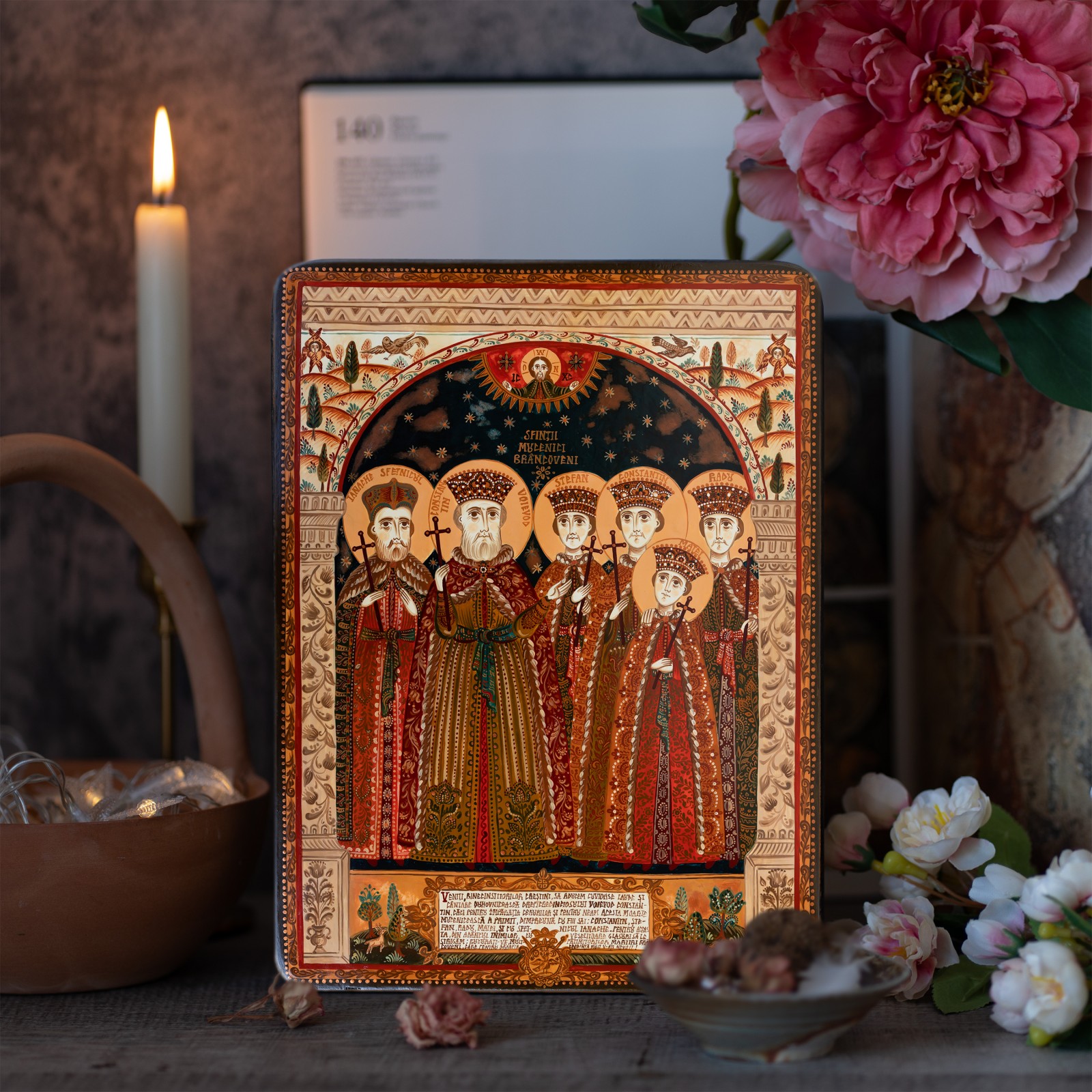
This hand-painted Orthodox wooden icon illustrates the Holy Brancoveanu Martyrs, commemorated by the Orthodox Church on August 16.
The icon is inspired by the frescoes found at the Hurezi Monastery, founded by Constantin Brâncoveanu and the place where the ruler wished to be buried.
The six Brâncoveanu martyrs are painted on a blue background with golden stars and are framed by a border that gives the impression of the exterior painting of the church porch and its columns. At the top is the Savior blessing. At the bottom of the icon is a box with a quote from the akathist hymn dedicated to the martyrs and the princely coat of arms of Constantin Brâncoveanu.
Original artwork in tempera colours by Ana Drăgan (DAM).
The holy Prince Constantine Brancoveanu, the son of Prince Matthew Basarab, was born in 1654. When his parents died, he was raised and educated by his uncle, Constantine Cantacuzino. When another uncle, Prince Serban Cantacuzino died on on October 19, 1688, Constantine was chosen to succeed him as Prince of the Romanian Land (Wallachia). Saint Constantine was a wise and just ruler who was guided by Christian principles, and worked for the benefit of his people. He also built and restored many churches and monasteries. His philanthropy extended even into Transylvania and Moldavia, which were ruled by others.
In 1714, after a reign of twenty-five years, Saint Constantine, his sons (Saints Constantine the Younger, Stephen Brancoveanu, Radu Brancoveanu, and Matthew Brancoveanu) and his sons-in-law were arrested by soldiers sent to Bucharest by Sultan Ahmed III (1703-1730). The prisoners were brought to Constantinople, where they were tortured for four months. Prince Constantine was told that if he and his sons wanted to escape death, they would have to convert to Islam and pay a large sum of money. Constantine did not have the money required by the Turks, and he did not wish to convert to the Moslem faith.
Seeing that neither tortures nor threats would induce the prisoners to forsake Christ, the Turks sentenced them to death. Before his own execution, Saint Constantine had to watch as his sons were beheaded before his eyes.
On the Feast of the Dormition (August 15), the sixty-year-old prince, his sons, and his counsellor Ianache Vacarescu died as martyrs for Christ. Their bodies were left unburied for three days, then they were thrown into the sea. Their relics were recovered by Orthodox Christians who brought them to the Monastery of the Theotokos on the island of Chalki.
Saint Constantine’s wife Marica brought his holy relics back to Bucharest and placed them in the church of Saint George the New, which he had founded. He was glorified by the Orthodox Church of Romania in 1992.


5
(1 reviews)
Select a row below to filter reviews.
Did you buy or received this product as a gift?
add_comment
Write your review
Frumos!
Pentru toate aceste lucrari- minunatii... bijuterii...nici nu stiu cum sa le numesc,eu va multumesc!